 © Region Hannover
Transformation: Baumert & Dabergotz Receives “Digital Jetzt” Funding for Cobot
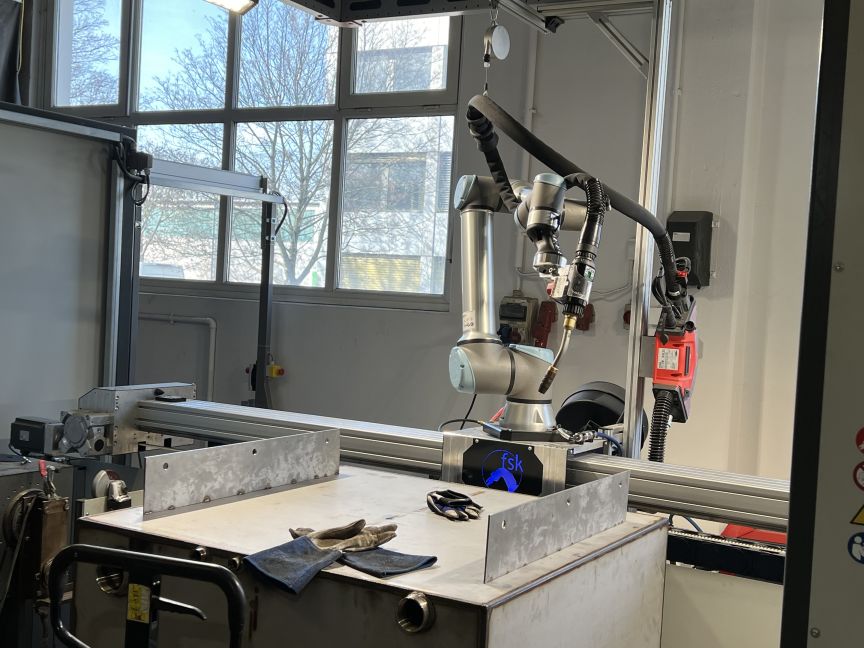
Baumert & Dabergotz GmbH, a metalworking company, has received funding through the “Digital Jetzt” grant for a digital investment in a cobot.


 © TEWISS/Phillip Becker
Manufacturing companies face the challenge of reducing material waste, accelerating production processes, and simultaneously making workplaces more ergonomic. Collaborative lightweight robots (cobots) represent a technology that can help companies achieve these goals. With RoboHub Lower Saxony, the Economic and Employment Development Agency of the Hannover Region, together with a consortium, is establishing an innovation lab that demonstrates the company-specific benefits of this technology to businesses.
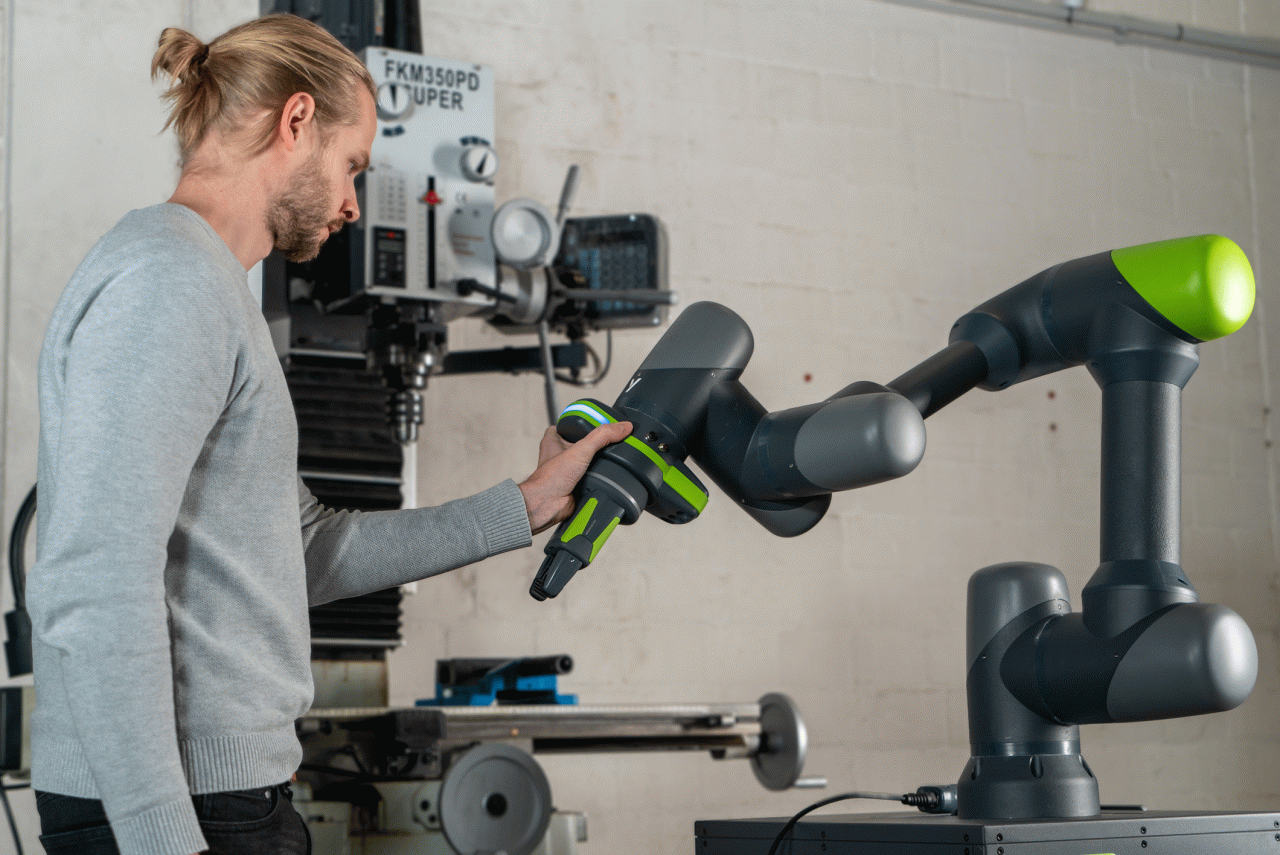
Cobots are permanently transforming the landscape of future production. Unlike traditional industrial robots, cobots are relatively easy to program and can operate without enclosures or extensive safety systems, such as light curtains.
Thanks to these characteristics, cobots enable cost-effective automation of processes for the first time—processes that were previously unprofitable due to low production volumes. This makes it possible to make on-site production processes more profitable, rather than having to outsource them to countries with lower manufacturing costs. In some cases, it is also possible to bring work processes back in-house, resulting in more resilient supply chains.
Alternatively, cobots can serve as assistance systems for manually performed work steps. For example, by supplying tools or assembly components, they improve ergonomics at workstations.
 © Woltersmann
However, companies are often still unaware of the specific possibilities this technology offers for optimizing their operation- and component-specific processes. As a result, many small industrial and craft businesses have yet to adopt cobots. TEWISS – Technik und Wissen GmbH, VISION Lasertechnik GmbH, the Institute for Assembly Technology and Industrial Robotics, and the Economic and Employment Development Agency of the Hannover Region are addressing this issue.
The RoboHub Lower Saxony therefore provides cobots and grippers from various suppliers. This test facility allows technical staff and managers from SMEs to gain hands-on experience with this technology through practical introductory workshops. In follow-up workshops, participants develop their first applications—if needed, even using a real component from their own company.
The use cases were implemented as part of the project “Cost-Effective Automation for Small Businesses” (Cobots in Production), funded by the Economic and Employment Development Agency of the Hannover Region. You can find potential use cases for deploying cobots in production—which can also be developed for your company at the RoboHub—here:
To enable companies and research institutions to develop further success stories from the network’s innovative ideas as quickly as possible, the Economic and Employment Development Agency of the Hannover Region is not only supporting RoboHub Lower Saxony with €20,000.
Individual company projects and collaborative initiatives in regional businesses are also funded with up to €10,000. The goal here is not only the efficient implementation of cobot applications with long-term utility, e.g., for welding sheet metal or loading milling machines.
The development of innovative hardware and software components, such as intelligent grippers, is also being considered. In addition, the innovation consultants at the Economic and Employment Development Agency assist interested companies in securing funding from the federal government or the state of Lower Saxony.

 © TEWISS/Phillip Becker
 © TEWISS/Phillip Becker
 © TEWISS/Phillip Becker
 © TEWISS/Phillip Becker
 © TEWISS/Phillip Becker
 © TEWISS/Phillip Becker
 © TEWISS/Phillip Becker
 © TEWISS/Phillip Becker
 © TEWISS/Phillip Becker
 © TEWISS/Phillip Becker
 © TEWISS/Phillip Becker
 © TEWISS/Phillip Becker
 © TEWISS/Phillip Becker
 © TEWISS/Phillip Becker
 © TEWISS/Phillip Becker